
Learn English With Us
learnenglishwithus.org
Noor · نور

A1 - A2 Level

📝 Grammar & Sentence Builder

قواعد اللغة الإنجليزية وبناء الجمل - مصمم للمتحدثين بالعربية
٢٠ درسًا تفاعليًا مع شرح كامل بالعربية. تعلّم ترتيب الكلمات، الأفعال، أدوات التعريف، الأزمنة، والمزيد - بتمارين عملية وتصحيح فوري.
📝 20 Lessons✏️ 160 Exercises🔤 Word Order + Fill-in-the-Blank🇸🇦 Arabic Explanations

Complete Grammar Reference

English Grammar Guide for Arabic Speakers

Each section below explains a grammar topic covered in the exercises above. Read the explanation, study the examples, learn from the common mistakes, and see how the grammar appears in real life. Use this guide as a reference anytime you need a quick reminder.

Unit 1 — Foundation

Lesson 1

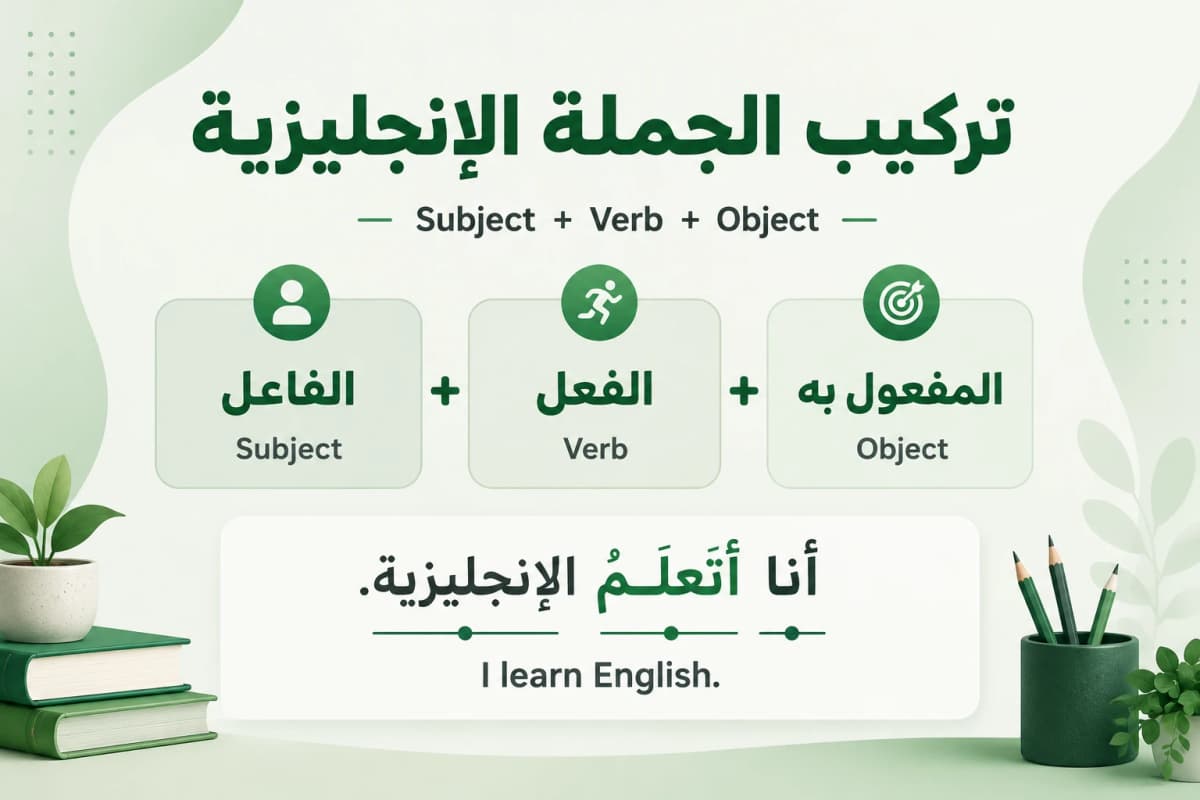
Word Order in English (SVO)

English sentences follow a strict Subject-Verb-Object order. Unlike Arabic, you cannot move the verb to the front or the object to the beginning without changing the meaning.

📖 The Grammar Rule

In English, every sentence has three core positions. The subject (who or what does the action) comes first. The verb (the action) comes second. The object (who or what receives the action) comes last. This pattern is called SVO - Subject, Verb, Object. Time expressions (yesterday, every day, at 9 am) usually go at the very end, or occasionally at the very beginning of a sentence - never in the middle.

✏️ Examples

  • She reads the report every morning.

  • Ahmed sends emails at work.

  • The team finished the project yesterday.

  • I drink coffee before meetings.

⚠️ Common Mistakes

  • Reads she the report.She reads the report.

    The subject always comes before the verb - never after it in a statement.

  • The report reads she every morning.She reads the report every morning.

    Do not move the object to the front in a normal statement.

  • She reads every morning the report.She reads the report every morning.

    Time expressions go at the end of the sentence, not between the verb and the object.

💼 Real-Life Usage

Context: Writing a work email

I attached the document. (Subject: I | Verb: attached | Object: the document)

My manager approved the budget yesterday.

Our team uses this system every day.

✅ Quick Recap

  • English word order: Subject -> Verb -> Object (SVO).
  • The subject always comes before the verb in a statement.
  • Time expressions go at the end (or start) - never in the middle.
  • Moving words around in English changes the meaning or makes the sentence incorrect.
  • Practise by writing one SVO sentence about your daily routine each morning.

Lesson 2

The Verb 'To Be' - am / is / are

The verb 'to be' is the most common verb in English. Arabic speakers often omit it because Arabic does not need a verb in simple descriptive sentences - but English always does.

📖 The Grammar Rule

Use 'am' with I. Use 'is' with he, she, it, or a singular noun. Use 'are' with you, we, they, or a plural noun. The verb 'to be' links the subject to a description (adjective, noun, or location). It is never optional in English, even when the meaning seems obvious without it.

✏️ Examples

  • I am a nurse.

  • She is from Riyadh.

  • They are in a meeting right now.

  • The office is on the third floor.

⚠️ Common Mistakes

  • She doctor.She is a doctor.

    'Is' cannot be dropped. Every English sentence needs a verb.

  • I am agree.I agree.

    Do not use 'am/is/are' before a verb. 'Agree' is already a verb.

  • They is ready.They are ready.

    Use 'are' with they, we, and you - not 'is'.

💼 Real-Life Usage

Context: Introducing yourself at work

Hi, I am Sara. I am the new accountant.

This is my colleague, Omar. He is from Jeddah.

We are happy to join this project.

✅ Quick Recap

  • am -> I only.
  • is -> he, she, it, singular noun.
  • are -> you, we, they, plural noun.
  • Never omit 'to be' - Arabic allows it, English does not.
  • Contractions: I'm, she's, they're - common in spoken and informal English.

Lesson 3

Articles - a, an, the

English has three articles: 'a', 'an', and 'the'. Arabic has only 'the' (ال). This makes articles one of the hardest areas for Arabic speakers - but the rules are learnable.

📖 The Grammar Rule

Use 'a' before consonant sounds and 'an' before vowel sounds when mentioning something for the first time, or when it is one of many. Use 'the' when both the speaker and listener know exactly which thing is being referred to - because it was mentioned before, or because there is only one. Some nouns need no article at all: languages (English), subjects (maths), meals (breakfast), and most countries.

✏️ Examples

  • I need a pen.

  • Can I borrow the pen on your desk?

  • She is an engineer.

  • I speak Arabic and English.

⚠️ Common Mistakes

  • I have meeting at three.I have a meeting at three.

    Singular countable nouns always need an article. 'Meeting' is countable.

  • She is the engineer.She is an engineer.

    Use 'a/an' for professions - 'the' suggests there is only one engineer.

  • I ate the breakfast.I ate breakfast.

    Meals (breakfast, lunch, dinner) do not take 'the' unless you specify which one.

💼 Real-Life Usage

Context: Describing your workplace

There is a café on the ground floor.

The café opens at seven.

I usually have a coffee and an apple before my shift.

✅ Quick Recap

  • a / an -> first mention, one of many, consonant / vowel sound.
  • the -> both parties know which one; only one exists.
  • No article -> languages, most countries, meals, subjects.
  • Countable singular nouns always need a/an or the.
  • When in doubt between 'a' and 'the', ask: 'Does my listener know which one?'

Lesson 4

Simple Present Tense

The simple present describes habits, facts, and routines. It is one of the most-used tenses in English, especially in professional and daily-life communication.

📖 The Grammar Rule

The base form of the verb is used with I, you, we, and they. Add '-s' or '-es' to the verb for he, she, and it. Use this tense for things that happen regularly (every day, always, usually), for facts that are always true, and for schedules (The train leaves at 8). Do not use it for something happening right now - that needs the present continuous.

✏️ Examples

  • I work in a bank.

  • She checks her email every morning.

  • Water boils at 100 degrees.

  • The office opens at eight.

⚠️ Common Mistakes

  • She work late every Friday.She works late every Friday.

    Add '-s' to the verb when the subject is he, she, or it.

  • He is work in IT.He works in IT.

    Do not combine 'is' with the base form of a main verb.

  • I am go to the gym on Mondays.I go to the gym on Mondays.

    Habits use the simple present - not 'am/is/are + verb'.

💼 Real-Life Usage

Context: Talking about your job routine

I start work at eight and finish at five.

My team meets every Tuesday morning.

Our manager reviews the reports on Thursdays.

✅ Quick Recap

  • Simple present = habits, facts, routines, schedules.
  • He/she/it -> add -s or -es to the verb.
  • I/you/we/they -> use the base verb, no change.
  • Never use 'is/am/are' before a main verb for habits.
  • Key signal words: every day, always, usually, often, never, on Mondays.

Lesson 5

Present Continuous - am/is/are + -ing

The present continuous describes what is happening right now, or a temporary situation around the present time. It is formed with the verb 'to be' plus the main verb ending in '-ing'.

📖 The Grammar Rule

To form the present continuous, use am/is/are followed by the verb with '-ing' added. Use it when an action is in progress at the moment of speaking, when a temporary situation is happening around now (even if not at this exact second), or for a fixed future arrangement. Contrast it with the simple present: 'I work in a bank' (habit) vs 'I am working from home today' (temporary).

✏️ Examples

  • I am writing a report right now.

  • She is studying for her IELTS exam this month.

  • They are renovating the office at the moment.

  • We are meeting the client tomorrow at two.

⚠️ Common Mistakes

  • She is work in the lab today.She is working in the lab today.

    You must add '-ing' to the main verb, not use the base form.

  • I am understanding this lesson.I understand this lesson.

    State verbs (know, understand, believe, like, want) do not use the continuous.

  • He working from home.He is working from home.

    Do not drop 'is' - the auxiliary verb 'to be' is required.

💼 Real-Life Usage

Context: A quick message to a colleague

Hi Khalid, I am finishing the slides right now.

Sara is checking the numbers at the moment.

We are presenting to the board at 3 pm today.

✅ Quick Recap

  • Structure: am/is/are + verb-ing.
  • Use for: right now, temporary situations, fixed future plans.
  • Not used with state verbs: know, understand, love, want, believe.
  • Contrast with simple present: 'I work' (always) vs 'I am working' (now/temporary).
  • Signal words: now, right now, at the moment, today, this week.

Unit 2 — Building Blocks

Lesson 6

Negation - Making Sentences Negative

To make a sentence negative in English, you add 'not' - but you must use it with an auxiliary verb. You cannot simply add 'not' to any word the way Arabic adds 'لا' or 'لم'.

📖 The Grammar Rule

For the simple present with I/you/we/they, use 'do not' (don't) before the base verb. For he/she/it, use 'does not' (doesn't). For 'to be', add 'not' directly after: is not (isn't), are not (aren't), am not. For the present continuous, add 'not' after is/are: is not working, are not coming. Never add 'not' to the main verb itself - the auxiliary carries the negation.

✏️ Examples

  • I don't have a meeting today.

  • She doesn't work on Fridays.

  • The bank isn't open on weekends.

  • We aren't ready for the presentation.

⚠️ Common Mistakes

  • She doesn't works here.She doesn't work here.

    After 'doesn't', use the base verb - no '-s'. The auxiliary carries the he/she/it agreement.

  • I not understand.I don't understand.

    You need the auxiliary 'do/does' to form the negative - 'not' alone is not enough.

  • He no have time.He doesn't have time.

    'No' is not a verb negator. Use 'don't/doesn't' before the verb.

💼 Real-Life Usage

Context: Politely declining or clarifying at work

I don't have access to that file - please ask the manager.

The system doesn't work after 10 pm.

We aren't accepting new applications this month.

✅ Quick Recap

  • don't (do not) -> I, you, we, they + base verb.
  • doesn't (does not) -> he, she, it + base verb.
  • isn't / aren't / am not -> negation of 'to be'.
  • After don't/doesn't, use the base verb (no -s, no -ing).
  • Contractions (don't, doesn't, isn't) are standard in everyday English.

Lesson 7

Asking Questions - Do / Does / Is / Are

Forming questions in English requires inverting the subject and auxiliary verb. Unlike Arabic, you cannot simply raise your voice - the word order must change.

📖 The Grammar Rule

For yes/no questions with the simple present, move 'do' (I/you/we/they) or 'does' (he/she/it) to the front. The main verb stays as the base form. For 'to be' questions, move 'is', 'are', or 'am' to the front. For Wh- questions (what, where, when, who, why, how), place the question word first, then the auxiliary, then the subject, then the base verb.

✏️ Examples

  • Do you speak English?

  • Does she work here?

  • Is the office open today?

  • Where do you study?

⚠️ Common Mistakes

  • You work here?Do you work here?

    English requires the auxiliary 'do/does' in yes/no questions - rising intonation alone is not enough in formal writing.

  • Does she works here?Does she work here?

    After 'does', use the base verb - the '-s' is already on 'does'.

  • Where you go?Where do you go?

    Wh- questions need the auxiliary 'do/does' after the question word.

💼 Real-Life Usage

Context: Job interview or meeting

Do you have experience with this software?

Does the position require travel?

What time does the meeting start?

Where is the HR department?

✅ Quick Recap

  • Yes/No: Do/Does + subject + base verb?
  • To Be: Is/Are + subject + adjective/noun?
  • Wh-: Question word + do/does + subject + base verb?
  • Never add '-s' to the verb after 'does'.
  • Question word order: QASV - Question word, Auxiliary, Subject, Verb.

Lesson 8

Prepositions of Time and Place - in / on / at

The prepositions 'in', 'on', and 'at' are used for both time and place. Arabic speakers often confuse them because Arabic uses different prepositions with different logic.

📖 The Grammar Rule

For time: 'at' is used with exact times (at 9 am, at noon, at midnight) and fixed phrases (at the weekend). 'On' is used with days and dates (on Monday, on 15 March). 'In' is used with months, seasons, years, and longer periods (in January, in 2024, in the morning). For place: 'at' marks a specific point (at the airport, at the desk). 'On' marks a surface (on the table, on the wall). 'In' marks an enclosed space (in the office, in the city).

✏️ Examples

  • The meeting is at 10 am.

  • We work on Saturdays.

  • She was born in March 1995.

  • The files are in the top drawer.

⚠️ Common Mistakes

  • I will see you in Monday.I will see you on Monday.

    Use 'on' with days of the week.

  • The report is on the email.The report is in the email.

    Use 'in' for things inside a container - an email is a container of content.

  • She arrives at morning.She arrives in the morning.

    Use 'in the morning/afternoon/evening' - 'at' is for specific times only.

💼 Real-Life Usage

Context: Scheduling at the office

The training is on Wednesday at 2 pm in the main conference room.

In January, we usually have the annual review.

Please leave the forms on my desk by Friday.

✅ Quick Recap

  • at -> exact times, specific points (at 8, at the gate).
  • on -> days, dates, surfaces (on Monday, on the table).
  • in -> months, years, periods, enclosed spaces (in March, in the office).
  • Common fixed phrases: at the weekend, in the morning, on time.
  • Never use 'at morning' - always 'in the morning'.

Lesson 9

There is / There are

'There is' and 'there are' are used to say that something exists or is present in a place. This structure is common in descriptions, emails, and everyday speech.

📖 The Grammar Rule

Use 'there is' (or 'there's') with singular or uncountable nouns. Use 'there are' with plural nouns. The word 'there' is not a location here - it is a grammatical placeholder to introduce the real subject. To make the negative, say 'there isn't' or 'there aren't'. To ask a question, invert: 'Is there a...?' or 'Are there any...?'

✏️ Examples

  • There is a problem with the system.

  • There are three emails in your inbox.

  • Is there a meeting room available?

  • There isn't enough time to finish today.

⚠️ Common Mistakes

  • There are a solution.There is a solution.

    'Solution' is singular - use 'there is'.

  • Is there any chairs?Are there any chairs?

    'Chairs' is plural - use 'are there'.

  • There is no have a printer.There isn't a printer.

    Use 'there isn't/aren't' to make this structure negative - not 'no have'.

💼 Real-Life Usage

Context: Describing an office or hotel room

There is a projector in the main meeting room.

There are two elevators on the left side.

There isn't a parking space available today.

Are there any vegetarian options on the menu?

✅ Quick Recap

  • there is → singular noun or uncountable noun.
  • there are → plural noun.
  • Negative: there isn't / there aren't.
  • Question: Is there...? / Are there any...?
  • 'There' here is grammatical — it does not mean a physical place.

Lesson 10

Can and Can't — Ability and Permission

'Can' expresses ability (I can swim), possibility, or permission (You can leave early). 'Can't' is the negative. It is one of the most versatile modal verbs in English.

📖 The Grammar Rule

Use 'can' before the base form of any verb — no '-s', no '-ing', no 'to'. It does not change for he/she/it. To express the negative, use 'cannot' (formal) or 'can't' (everyday). To ask a question, move 'can' before the subject. Use 'can' for: natural ability (she can run fast), learned skills (I can speak Arabic), polite requests (Can you help me?), and permission (You can use my computer).

✏️ Examples

  • I can speak three languages.

  • She can't attend the meeting today.

  • Can you send me the file?

  • You can park here after 6 pm.

⚠️ Common Mistakes

  • She cans drive.She can drive.

    Modal verbs never take '-s' — not even with he/she/it.

  • I can to swim.I can swim.

    After 'can', use the base verb without 'to'.

  • Can you to help me?Can you help me?

    No 'to' after modal verbs. The base form follows directly.

💼 Real-Life Usage

Context: In an office or on a phone call

Can I speak to the manager, please?

I can send the invoice by Friday.

Sorry, I can't make it to the meeting — can we reschedule?

✅ Quick Recap

  • can + base verb (no to, no -s, no -ing).
  • Same form for all subjects — no change for he/she/it.
  • Negative: can't / cannot.
  • Question: Can + subject + base verb?
  • Used for: ability, possibility, requests, permission.

Unit 3 — Expanding

Lesson 11

Pronouns — Subject and Object

Pronouns replace nouns to avoid repetition. English has two sets: subject pronouns (I, you, he…) used before verbs, and object pronouns (me, you, him…) used after verbs and prepositions.

📖 The Grammar Rule

Subject pronouns act as the subject of a verb: I, you, he, she, it, we, they. Object pronouns receive the action or follow a preposition: me, you, him, her, it, us, them. In English, pronouns must agree with the noun they replace in gender (he/she) and number (it/they). Notably, 'you' is both singular and plural, formal and informal. 'It' is used for things, animals (usually), and weather/time/distance.

✏️ Examples

  • She called me this morning.

  • I sent him the report.

  • They invited us to the conference.

  • It is raining outside.

⚠️ Common Mistakes

  • Me and my friend went to the office.My friend and I went to the office.

    Use 'I' as the subject, not 'me'. Put yourself last as a matter of politeness.

  • The manager spoke to I.The manager spoke to me.

    After prepositions, use object pronouns (me, him, her, us, them).

  • Everyone should bring their own pen.Everyone should bring their own pen. ✓

    'Their' with 'everyone' is now standard in formal and informal English.

💼 Real-Life Usage

Context: Writing a formal email

I am writing to inform you that we have reviewed your application.

Please contact us if you have any questions.

She will call you back within 24 hours.

✅ Quick Recap

  • Subject pronouns (before verb): I, you, he, she, it, we, they.
  • Object pronouns (after verb/preposition): me, you, him, her, it, us, them.
  • Use 'it' for things, animals, weather, time.
  • Say 'My friend and I' — not 'Me and my friend' — as the subject.
  • 'You' serves both singular and plural — context makes it clear.

Lesson 12

Past Simple Tense

The past simple describes completed actions in the past. Regular verbs add '-ed'. Irregular verbs have their own forms that must be memorised — but the most common ones appear very often, so they become natural quickly.

📖 The Grammar Rule

Regular verbs: add '-ed' (work → worked, call → called, finish → finished). Spelling rules: verbs ending in '-e' add only '-d' (live → lived). Verbs ending in consonant + vowel + consonant double the final consonant (stop → stopped). For negatives, use 'did not' (didn't) + base verb. For questions, use 'Did' + subject + base verb. 'Did' carries all the past meaning, so the main verb goes back to the base form.

✏️ Examples

  • I worked late last night.

  • She sent the contract on Monday.

  • Did you finish the report?

  • We didn't receive your email.

⚠️ Common Mistakes

  • She didn't sent the email.She didn't send the email.

    After 'didn't', use the base verb — not the past form.

  • Did you worked yesterday?Did you work yesterday?

    After 'did', the main verb returns to its base form.

  • I am went to the bank.I went to the bank.

    Do not combine 'am/was' with the past form of a main verb.

💼 Real-Life Usage

Context: Reporting what happened at work

I called the client twice but she didn't answer.

We finished the project two days ahead of schedule.

Did the supplier send the invoice last week?

✅ Quick Recap

  • Regular verbs: add -ed (worked, called, finished).
  • Common irregular verbs: go→went, send→sent, have→had, come→came, take→took.
  • Negative: didn't + base verb.
  • Question: Did + subject + base verb?
  • After 'did'/'didn't', the main verb is always in the base form.

Lesson 13

Plurals — Regular and Irregular

Most English nouns form their plural by adding '-s'. But many common nouns are irregular. Knowing the patterns saves time and avoids frequent spelling mistakes.

📖 The Grammar Rule

Regular plurals: add '-s' (book → books, office → offices). Add '-es' after s, sh, ch, x, z (bus → buses, box → boxes). Words ending in consonant + y change y to i and add '-es' (city → cities). Words ending in '-f' or '-fe' often change to '-ves' (life → lives, shelf → shelves). Common irregular plurals include: man → men, woman → women, child → children, person → people, tooth → teeth, foot → feet, mouse → mice. Uncountable nouns (information, advice, water, money) have no plural form.

✏️ Examples

  • The company has three branches in Riyadh.

  • I need the files from both offices.

  • All the children passed the test.

  • The advice was very helpful.

⚠️ Common Mistakes

  • I have two informations.I have some information.

    'Information' is uncountable — it has no plural. Say 'some information' or 'two pieces of information'.

  • Childs are welcome.Children are welcome.

    The plural of 'child' is 'children' — not 'childs'.

  • The womans in our team are very skilled.The women in our team are very skilled.

    The plural of 'woman' is 'women'.

💼 Real-Life Usage

Context: Describing team members or office items

We have five branches and over two hundred employees.

All managers submitted their reports on time.

The HR team needs new chairs for the meeting rooms.

✅ Quick Recap

  • Most nouns: add -s.
  • After s/sh/ch/x/z: add -es.
  • Consonant + y → -ies (city → cities).
  • Common irregulars: child/children, man/men, woman/women, person/people.
  • Uncountable nouns (information, advice, money) have no plural form.

Lesson 14

Adjective Order

When you use more than one adjective in English, they follow a strict natural order. Native speakers follow this order instinctively — and breaking it sounds unnatural, even if the meaning is clear.

📖 The Grammar Rule

The standard order is: Opinion → Size → Age → Shape → Colour → Origin → Material → Purpose + Noun. A helpful mnemonic is OSASCOMP. In practice, you rarely use more than two or three adjectives at once. Opinion adjectives (beautiful, terrible, useful) always come first. Colour comes before origin (a red Italian car, not an Italian red car). Purpose adjectives sit closest to the noun (a metal filing cabinet — 'filing' is purpose).

✏️ Examples

  • She has a beautiful small silver ring.

  • He drives a big old German car.

  • We need a long black leather strap.

  • It is a new modern French restaurant.

⚠️ Common Mistakes

  • a German old big cara big old German car

    Order: Size (big) → Age (old) → Origin (German).

  • a red beautiful baga beautiful red bag

    Opinion (beautiful) comes before Colour (red).

  • a wooden big tablea big wooden table

    Size comes before Material.

💼 Real-Life Usage

Context: Describing products or items at work

We are looking for a large round conference table.

She bought an elegant dark blue business suit.

The company logo is a simple red Arabic design.

✅ Quick Recap

  • Order: Opinion → Size → Age → Shape → Colour → Origin → Material → Purpose.
  • You rarely need more than two or three adjectives together.
  • Opinion always comes first; purpose always comes last (before the noun).
  • When in doubt: would it sound odd reversed? Keep the natural order.
  • Commas: adjectives of the same type sometimes take a comma (a long, tiring day).

Lesson 15

Countable and Uncountable Nouns

Some nouns can be counted (one book, two books). Others cannot — they refer to things treated as a whole mass (water, advice, information). This distinction changes the words you use with them.

📖 The Grammar Rule

Countable nouns have a singular and plural form. Use 'a/an' with the singular. Use 'many' or 'a number of' with the plural. Uncountable nouns have only one form — no plural, no 'a/an'. Use 'much' or 'a lot of' with uncountable nouns in questions and negatives. Use 'some' for both in positive sentences. Common uncountable nouns: information, advice, news, money, water, rice, luggage, furniture, traffic, knowledge, progress, research.

✏️ Examples

  • I need some advice about this situation.

  • We don't have much time left.

  • She has a lot of experience in finance.

  • There are many opportunities in this city.

⚠️ Common Mistakes

  • Can I have an information?Can I have some information?

    'Information' is uncountable — no 'a/an' and no plural.

  • She gave me a good advice.She gave me some good advice.

    'Advice' is uncountable. Use 'a piece of advice' if you want the singular idea.

  • How many money do you have?How much money do you have?

    Use 'much' (not 'many') with uncountable nouns.

💼 Real-Life Usage

Context: Professional conversations

We have received a lot of feedback on the new system.

Could you give me some information about the training schedule?

There isn't much time — let's focus on the key points.

✅ Quick Recap

  • Countable → singular/plural, a/an, many (How many books?).
  • Uncountable → one form, no a/an, much (How much money?).
  • Both take 'some' and 'a lot of' in positive sentences.
  • Common uncountables: information, advice, news, luggage, furniture, progress.
  • Use 'a piece of' to count uncountables: a piece of advice, a piece of news.

Unit 4 — Connecting

Lesson 16

Possessives — Showing Ownership

English shows possession in two main ways: the apostrophe-s ('s) attached to the owner, and possessive pronouns (my, your, his, her…). Knowing when to use each is essential for writing and speaking clearly.

📖 The Grammar Rule

For nouns, add apostrophe + s ('s) to the owner: 'the manager's office', 'Ahmed's report'. For plural nouns ending in -s, add only an apostrophe: 'the employees' contracts'. Possessive adjectives (my, your, his, her, its, our, their) come before the noun. Possessive pronouns (mine, yours, his, hers, ours, theirs) replace the noun entirely — they stand alone. Do not confuse 'its' (possession) with 'it's' (it is).

✏️ Examples

  • This is the director's office.

  • My password is different from yours.

  • The company's policy is very clear.

  • The employees' salaries are paid monthly.

⚠️ Common Mistakes

  • Its a great opportunity.It's a great opportunity.

    'Its' = belonging to it. 'It's' = it is. They sound identical — check by expanding: 'It is a great opportunity'.

  • The report of Ahmed is ready.Ahmed's report is ready.

    For people, 's is more natural and shorter than 'of + person'.

  • This bag is her.This bag is hers.

    Standalone possessive pronouns: mine, yours, his, hers, ours, theirs — not the adjective form.

💼 Real-Life Usage

Context: Office and professional writing

Please review the client's proposal by tomorrow.

Our team's results exceeded expectations this quarter.

The new system is mine — I set it up last week.

✅ Quick Recap

  • Singular owner: add 's (the boss's desk).
  • Plural owner ending in -s: add ' only (the managers' reports).
  • Possessive adjectives (before noun): my, your, his, her, its, our, their.
  • Possessive pronouns (stand alone): mine, yours, his, hers, ours, theirs.
  • Its (no apostrophe) = possession. It's = it is.

Lesson 17

Adverbs of Frequency

Adverbs of frequency tell us how often something happens. They are essential for describing routines, habits, and work schedules — and they have a specific position in the sentence.

📖 The Grammar Rule

The main adverbs of frequency, from most to least: always (100%), usually / normally, often, sometimes, occasionally, rarely / seldom, never (0%). Position: place adverbs of frequency between the subject and the main verb (I always check my email), or after the verb 'to be' (She is always on time). In questions and negatives, they sit after the subject but before the main verb: 'Do you always work late?' 'I don't usually eat lunch at my desk.'

✏️ Examples

  • I always send a confirmation email after a meeting.

  • She is usually the first to arrive.

  • We rarely cancel a deadline.

  • Do you often travel for work?

⚠️ Common Mistakes

  • I check always my email in the morning.I always check my email in the morning.

    The adverb comes before the main verb, not after it.

  • She is late never.She is never late.

    After 'to be', the adverb comes immediately after the verb — not at the end.

  • Always I start work at eight.I always start work at eight.

    Adverbs of frequency (except 'sometimes') do not go at the start of the sentence.

💼 Real-Life Usage

Context: Describing work habits in an interview

I always prepare an agenda before a meeting.

I rarely miss a deadline — I plan ahead.

We usually review the quarterly targets in January.

✅ Quick Recap

  • Scale: always → usually → often → sometimes → occasionally → rarely → never.
  • Position: subject + adverb + main verb.
  • After 'to be': subject + to be + adverb.
  • 'Sometimes' can also appear at the start or end of a sentence.
  • Never say 'I check always' — the adverb must come before the main verb.

Lesson 18

Demonstratives — this / that / these / those

'This', 'that', 'these', and 'those' point to specific things. The choice depends on distance — whether the thing is near (this/these) or far (that/those) — and on whether it is singular or plural.

📖 The Grammar Rule

Near and singular → this. Near and plural → these. Far and singular → that. Far and plural → those. 'Near' and 'far' can be physical (this pen in my hand vs that door over there) or conceptual — 'that's interesting' can refer to something just said. Demonstratives can act as pronouns (This is my office.) or adjectives before a noun (This office is mine.). In formal writing, 'that' and 'those' are often used to refer back to something mentioned earlier.

✏️ Examples

  • This document needs your signature.

  • These reports are from last quarter.

  • That was a very productive meeting.

  • Those files should be archived.

⚠️ Common Mistakes

  • These information is important.This information is important.

    'Information' is uncountable — singular. Use 'this', not 'these'.

  • I need those document on your desk.I need that document on your desk.

    'Document' is singular — use 'that', not 'those'.

  • This are my colleagues.These are my colleagues.

    Use 'these' with plural nouns and plural verbs.

💼 Real-Life Usage

Context: Presenting in a meeting or showing documents

This graph shows our growth over the past six months.

Those figures on the left are from the previous year.

Can you pass me those documents from the printer?

✅ Quick Recap

  • this → near, singular.
  • these → near, plural.
  • that → far, singular.
  • those → far, plural.
  • Match the demonstrative to the noun: singular noun → this/that; plural → these/those.

Lesson 19

Conjunctions — and / but / or / because / so

Conjunctions join ideas together. 'And', 'but', 'or', 'because', and 'so' are the five most important in everyday English. Using them correctly makes your speaking and writing flow naturally.

📖 The Grammar Rule

And adds information (I work hard and I enjoy my job). But shows contrast or unexpected information (The report is finished, but I haven't sent it). Or offers a choice (You can call me or send an email). Because introduces a reason — it follows the result (I was late because the traffic was heavy). So introduces a result — it follows the reason (The traffic was heavy, so I was late). Note: in formal writing, avoid starting a sentence with 'And', 'But', or 'So' — though this is common in informal speech.

✏️ Examples

  • She is experienced and very reliable.

  • The price is high, but the quality is excellent.

  • You can pay by card or in cash.

  • I left early because I had a meeting in Jeddah.

⚠️ Common Mistakes

  • I am tired because I will go to bed.I am tired, so I will go to bed.

    'Because' introduces the reason, not the result. Use 'so' before the result.

  • She is smart but she works hard.She is smart and she works hard.

    Use 'but' only when the second idea is unexpected or contrasts the first.

  • He did not come because he had no excuse.He did not come, and he gave no excuse.

    Be careful with 'because' — it must introduce a genuine reason.

💼 Real-Life Usage

Context: Writing a business message

We reviewed the proposal and we have a few questions.

The deadline is Friday, so please send the draft by Thursday.

You can call us or send your query by email — both work.

✅ Quick Recap

  • and → addition.
  • but → contrast / unexpected.
  • or → choice / alternative.
  • because → reason (result + because + reason).
  • so → result (reason + so + result).

Lesson 20

Future with 'Going To'

'Going to' expresses plans and intentions that have already been decided, and predictions based on what you can see right now. It is the most natural way to talk about the near future in everyday English.

📖 The Grammar Rule

Structure: subject + am/is/are + going to + base verb. Use 'going to' when you have already decided something (I am going to apply for this job) or when there is clear evidence for a prediction (Look at those clouds — it is going to rain). For questions: Am/Is/Are + subject + going to + base verb? For negatives: am/is/are + not going to + base verb. Note the difference from 'will': 'will' is for instant decisions and promises; 'going to' is for pre-made plans.

✏️ Examples

  • I am going to start a new course next month.

  • She is going to present the results on Thursday.

  • Are you going to attend the training?

  • We aren't going to change the deadline.

⚠️ Common Mistakes

  • She is going to presents the report.She is going to present the report.

    After 'going to', use the base verb — no -s, no -ing.

  • I going to call them tomorrow.I am going to call them tomorrow.

    Do not drop 'am/is/are' — the auxiliary is required.

  • We are going to to finish by Friday.We are going to finish by Friday.

    Do not write 'to to' — 'going to' already includes 'to'.

💼 Real-Life Usage

Context: Planning ahead at work or for travel

We are going to expand into the Gulf market next year.

I am going to book the flights this week.

Is the company going to hire more staff for the project?

✅ Quick Recap

  • Structure: am/is/are + going to + base verb.
  • Use for: pre-decided plans, intentions, evidence-based predictions.
  • Negative: am/is/are + not going to.
  • Question: Am/Is/Are + subject + going to + base verb?
  • Difference from 'will': 'I'll help' (instant decision) vs 'I'm going to help' (already planned).

All 20 grammar topics above are covered in the interactive exercises at the top of this page. Complete each lesson to earn your A1 Grammar certificate.